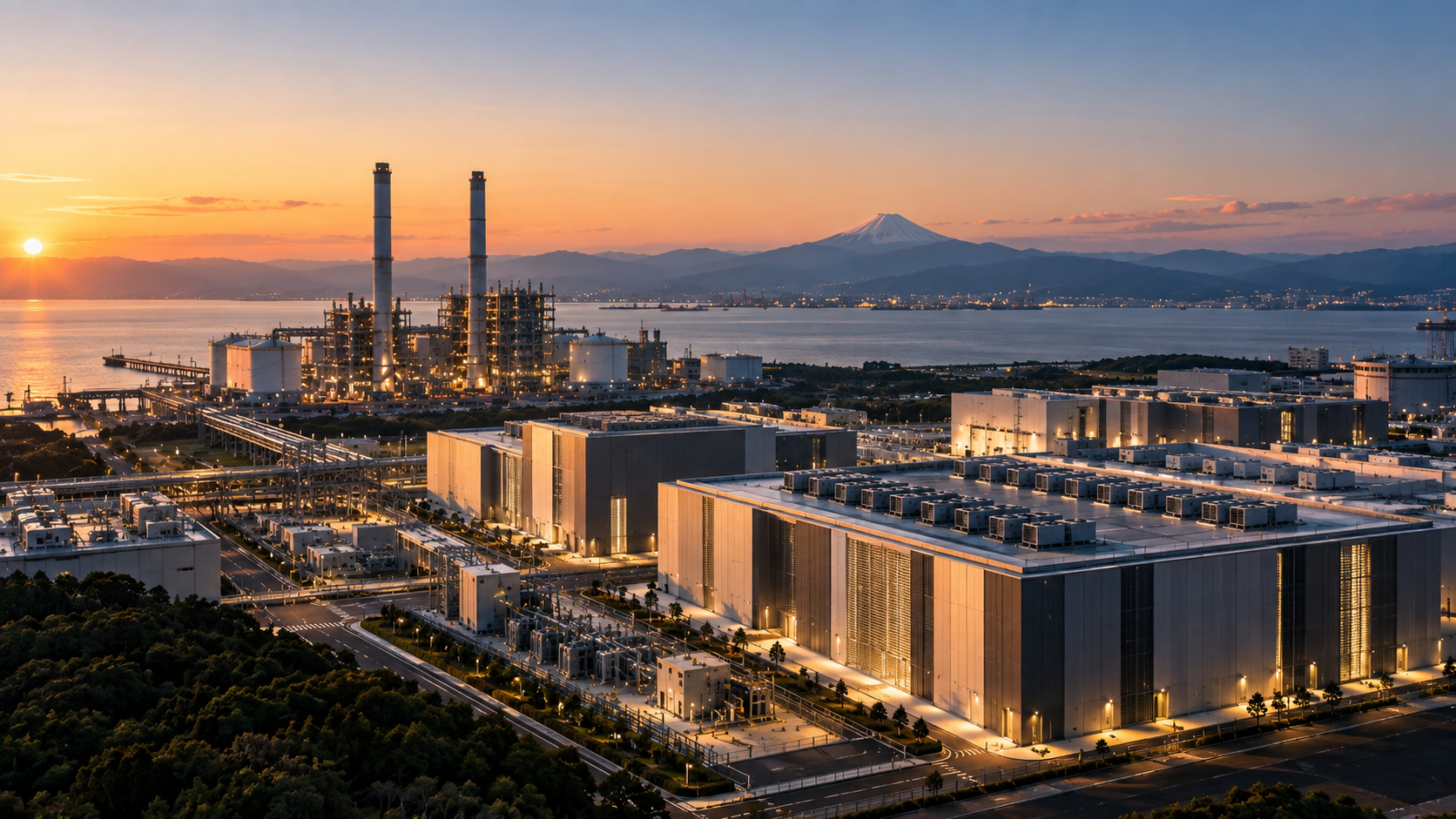
The AI race is moving beyond models and semiconductors. Japan’s latest infrastructure initiative shows why power, compute, capital and execution are converging into one integrated industrial strategy.
AI is entering the physical economy
Artificial intelligence is often described as a digital industry. Economically, it is becoming one of the most capital-intensive physical infrastructure cycles of the decade.
Data centres require land, power generation, substations, transformers, cooling, fibre connectivity, semiconductor supply chains and substantial amounts of financial capital before a model processes its first commercial workload.
The International Energy Agency expects global data-centre electricity consumption to more than double to approximately 945 TWh by 2030—slightly more than Japan’s current total electricity consumption. AI is expected to be the most important driver of that increase. International Energy Agency
That changes the nature of competitive advantage.
A company can acquire chips, license models and raise capital. What it cannot necessarily obtain quickly is several hundred megawatts of reliable electricity, appropriately located land, cooling infrastructure and the physical systems required to operate high-density compute at scale.
The constraint is therefore moving upstream. AI capacity is becoming a function not only of technology, but of the ability to coordinate industries that historically operated independently:
- energy;
- telecommunications;
- construction;
- hardware;
- infrastructure finance;
- real estate; and
- cloud architecture.
The countries and corporate platforms capable of coordinating those layers may acquire an advantage that is considerably harder to replicate than access to any single technology.
Sovereignty is increasingly about orchestration, not autarky
The term sovereign AI can easily be interpreted too narrowly. It does not necessarily mean that every component of an AI ecosystem must be domestically owned or produced.
The Japanese example suggests something more practical. JERA contributes domestic sites, generation capacity and an extensive LNG and power infrastructure. Dell contributes a standardised AI compute layer. RHAELM is expected to lead infrastructure development and integration. Apollo is positioned as a potential long-term capital provider. JERA
The resulting infrastructure may be strategically anchored in Japan even though its technology, capital and expertise are assembled internationally.
For many economies, genuine technological autarky is neither realistic nor economically desirable. What matters more is whether critical capacity can be secured, governed, expanded and operated within an architecture compatible with national requirements.
Japan’s policy direction already reflects this logic. Its government has developed the concept of “Watt-Bit Collaboration”: the coordinated development of electricity and telecommunications infrastructure to accelerate data-centre deployment and better align where power is available with where digital infrastructure is located. The country’s GX Strategic Area framework similarly seeks to encourage new industrial clusters around power availability, data centres and energy infrastructure. Ministry of Economy, Trade and Industry
Sovereign capacity, in this sense, is less about isolation. It is about control over the conditions required to operate at scale.
Time-to-power is becoming time-to-market
The most strategically important element of the Chiba project may not be its $15 billion headline. It may be its electricity architecture.
The planned facility would receive power behind the meter from JERA’s existing generation asset rather than relying exclusively on the timetable of a conventional new grid connection. JERA says this could allow compute capacity to become available several years earlier than under a traditional grid-connected development schedule.
For AI infrastructure, that changes the economics of time. A 400 MW site commissioned several years earlier is not merely an infrastructure asset delivered sooner. It represents earlier access to compute, customer capacity, revenue generation, learning effects and potentially the ability to train or operate strategically important models.
In AI infrastructure, time-to-power is becoming time-to-market.
This has implications for valuation and investment underwriting. Two sites with identical theoretical power capacity are not economically equivalent if one can provide usable electricity in two years and the other in six. Similarly, a jurisdiction offering attractive taxation but uncertain power delivery may be less competitive than one able to provide faster infrastructure execution.
Behind-the-meter solutions can therefore create strategic value by reducing one of the principal dependencies in the development sequence. But they do not eliminate infrastructure risk.
The Chiba announcement remains a proposed development under an MoU, and its planned economics still depend on successful execution across construction, equipment, financing and compute deployment. The model also relies materially on reliable gas-fired generation and a resilient LNG value chain, which JERA explicitly identifies as important to scaling Japan’s AI infrastructure.
Speed must therefore be distinguished from certainty.
Standardisation may matter as much as scale
Large data centres already exist. What makes the Japanese initiative strategically interesting is the ambition to create a repeatable architecture.
The partners intend to standardise the integration of power generation, electrical infrastructure, cooling and compute rather than redesigning the entire system around each individual project. Dell’s role includes providing pre-integrated rack-scale infrastructure, while RHAELM is expected to integrate the physical and compute layers into a model capable of replication across sites.
This moves AI infrastructure closer to industrial production. The first generation of major projects can be bespoke. A national infrastructure programme cannot.
At scale, repeatability matters because it can reduce engineering complexity, shorten procurement cycles and make operating performance and capital requirements more predictable. It can also improve financeability.
Capital providers are generally more comfortable underwriting a second, third or fourth deployment when the technical architecture, contractual framework and operating model have already been demonstrated. Standardisation can therefore create a financial advantage as well as an engineering advantage.
The financing proposition gradually changes from funding an individual data centre to funding a replicable infrastructure platform.
That distinction is significant for institutional capital. A single project may justify project-level financing. A repeatable multi-site architecture can begin to attract infrastructure funds, private credit, strategic capital and institutional investors at platform level.
Private capital then becomes part of the industrial scaling mechanism rather than simply a source of financing after the infrastructure strategy has been determined.
Existing energy assets can acquire a new strategic function
The AI infrastructure cycle may also change how certain existing power assets are valued strategically.
Thermal generation sites were historically assessed primarily through electricity-market economics: fuel costs, dispatch, capacity factors, regulation and the expected life of the asset. AI creates another possible source of value.
A power station may also possess land, high-capacity electrical infrastructure, fuel logistics, grid connections, industrial permitting history, access to water or cooling systems, and an operating workforce. Those attributes can be difficult and time-consuming to reproduce elsewhere.
Co-locating compute can therefore create a new economic use around infrastructure that already exists.
This does not mean every power station becomes a viable AI campus. Nor does it remove the carbon implications of serving additional digital demand from thermal generation. But it introduces a broader question for utilities and infrastructure owners:
Could existing energy assets be repositioned as platforms for the next generation of digital industry?
For investors, this may create an increasingly important distinction between the value of the generating asset itself and the strategic value of the site, power access and infrastructure surrounding it.
Sovereign infrastructure also creates sovereign dependencies
The language of strategic infrastructure should not obscure the risks. Integrating power and compute can accelerate deployment, but it also concentrates dependencies.
The Japanese model described by JERA relies on large-scale, reliable gas generation and the country’s LNG supply chain. That provides dispatchable power, but Japan remains dependent on imported fuel.
The compute layer creates another dependency. AI hardware depreciates economically far faster than conventional infrastructure. A building may remain useful for decades; the servers inside it may face rapid technological obsolescence.
Customer concentration can also matter. Large AI facilities may depend on a relatively limited number of hyperscalers, sovereign workloads or major technology clients capable of consuming hundreds of megawatts.
Capital structure therefore needs to recognise the mismatch between long-duration physical infrastructure and shorter-duration technological cycles.
Debt maturity, leasing structures, equipment financing, residual-value assumptions, power commitments and customer contracts need to reflect where risk genuinely sits. A facility may look like infrastructure physically while behaving more like technology economically. The best models will need to accommodate both.
The lesson extends beyond AI
The significance of this development is broader than data centres. It illustrates a new model of international industrial competition.
For decades, companies evaluating a major investment largely compared labour, tax, land, logistics, regulation and market access. For increasingly capital-intensive industries, that framework is incomplete.
Management teams may also need to ask whether a jurisdiction can assemble reliable energy, specialised infrastructure, long-duration capital, supply chains, digital connectivity, government support and execution capability within the same timetable.
This matters for semiconductors, advanced manufacturing, battery production, defence, industrial automation, critical-minerals processing—and potentially any industry in which scale increasingly depends on scarce physical infrastructure.
The strategic question is therefore no longer simply: Where is the cheapest place to invest?
It becomes: Which jurisdiction can make the investment executable at the required scale and speed?
That is a far more consequential test.