Venture Global's latest infrastructure agreements highlight an important shift in corporate investment. Reliable electricity is increasingly influencing project viability, capital efficiency, industrial location and strategic execution. For CEOs, investors and mid-market companies, energy availability is becoming part of the investment case itself.
For many businesses, electricity has traditionally been treated as an operating expense rather than a strategic asset.
Management selected a location, developed an investment plan, secured financing and assumed that the necessary energy infrastructure would be available within an acceptable timeframe.
That assumption is becoming less reliable.
Across industrial manufacturing, logistics, digital infrastructure and other energy-intensive activities, the availability of dependable electricity is increasingly influencing investment decisions before construction begins.
The consequences extend beyond energy costs.
Limited grid capacity can delay commissioning, increase capital requirements, constrain production and change the economics of an otherwise attractive project.
On 15 October, Venture Global announced agreements with GE Vernova and Baker Hughes supporting the potential development of more than 10 gigawatts of additional privately generated power capacity in the United States.
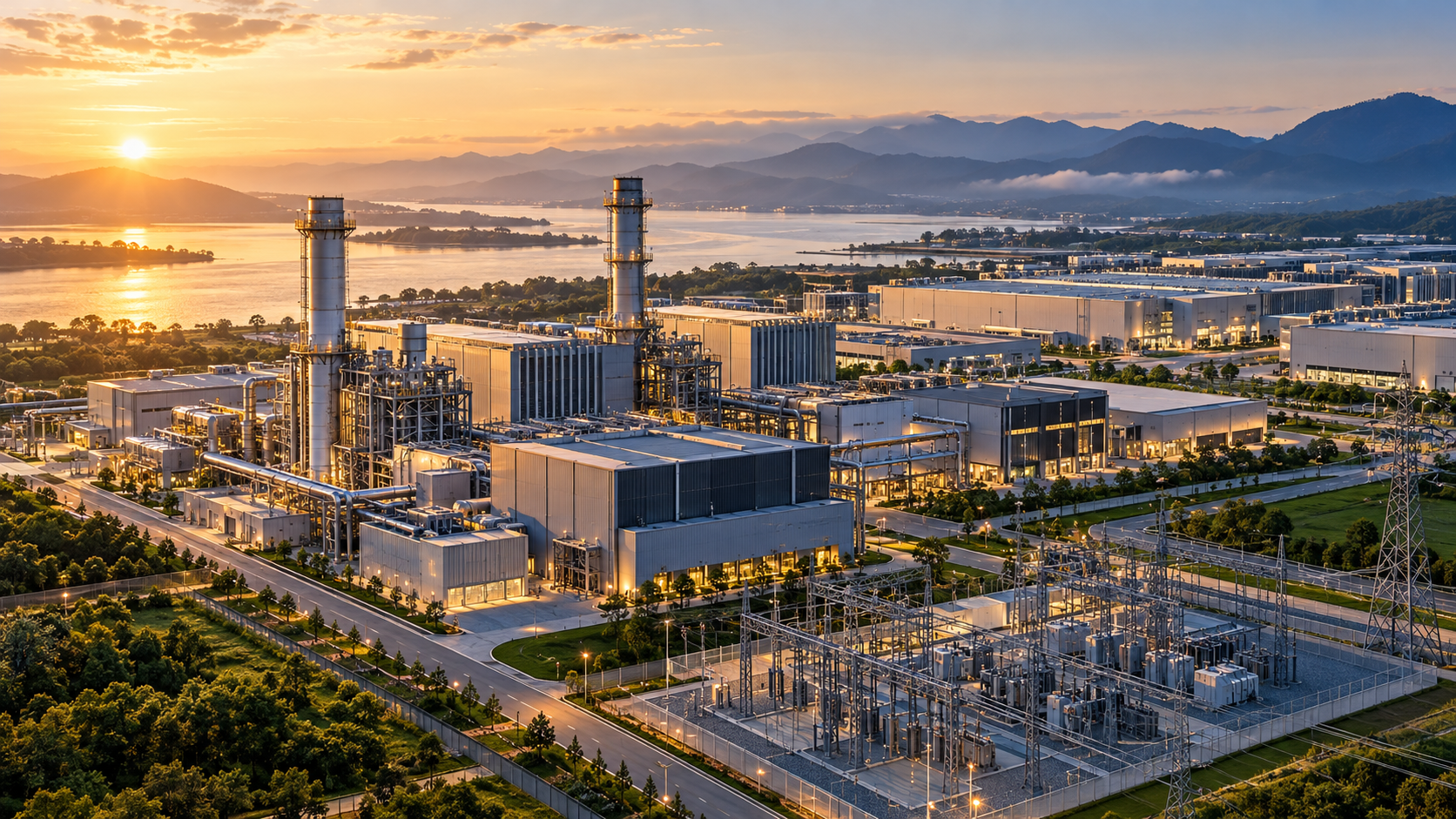
The initiative could eventually support large-scale industrial operations and adjacent data centres through dedicated electricity infrastructure operating independently of the public grid.
The announcement is significant not simply because of its scale, but because of the strategic approach it represents.
Venture Global is seeking to convert an existing industrial capability—developing and operating large-scale private electricity infrastructure—into a platform for additional commercial activities. Venture Global
The broader implication is relevant to companies operating at a very different scale.
Access to power is becoming part of the investment case itself.
1. Electricity Infrastructure Is Becoming a Strategic Constraint
The International Energy Agency expects global electricity consumption to grow by an average of approximately 3.6% annually between 2026 and 2030, compared with 2.8% over the preceding decade. IEA
That increase reflects a combination of industrial activity, transport electrification, cooling requirements, digital infrastructure and wider economic development.
However, electricity infrastructure does not necessarily expand at the same pace as demand.
In its 2026 assessment of electricity networks, the IEA identified at least 1,700 gigawatts of advanced-stage renewable generation projects and 600 gigawatts of utility-scale battery projects awaiting grid connections in 2025.
Network congestion generated an estimated US$12 billion in costs in the United States and €4.3 billion in the European Union during 2024. IEA
These figures reflect electricity-system constraints rather than a universal shortage of generation.
They nevertheless illustrate an important economic distinction.
A region may possess substantial potential generation capacity without having the infrastructure necessary to deliver that electricity to a specific industrial site.
For developers, this creates a disconnect between theoretical project attractiveness and practical execution.
An industrial facility may have access to land, financing, customers and equipment but remain unable to begin commercial operations because its electricity connection is delayed.
The resulting costs can be substantial.
Construction financing may need to be extended. Equipment can remain idle. Customer deliveries may be postponed, while assumptions underpinning the original investment case become progressively less reliable.
Energy availability therefore increasingly influences not only operating margins, but also project timing, financing requirements and investment returns.
2. Venture Global Illustrates a Different Industrial Model
Venture Global’s announcement provides a useful example of how companies are responding.
The American LNG producer has entered into framework agreements with GE Vernova and Baker Hughes covering up to 16 additional power-generation units, each with a nominal capacity of 720 megawatts.
The proposed expansion would build on approximately 4.5 gigawatts of modular, gas-fired generation already operating, under construction or on order across Venture Global’s LNG facilities.
Subject to customer commitments and other commercial conditions, the company believes the additional infrastructure could support up to 10 gigawatts of computing capacity by the end of 2034.
These figures represent potential capacity, not an unconditional commitment to construct or operate every proposed unit. Venture Global
The strategic significance lies in the company’s existing capabilities.
Venture Global has developed expertise in natural gas infrastructure, power generation, industrial project execution and integrated operations.
It is now examining how those capabilities could support additional customers and activities.
Rather than viewing electricity generation exclusively as an internal service required for LNG production, the company is exploring its potential as a broader commercial platform.
This is an example of adjacent diversification built around an established operating capability.
Such diversification can create attractive opportunities when the underlying infrastructure, expertise and commercial relationships are transferable.
However, the economic case still depends on customer demand, execution costs and the ability to maintain appropriate separation between existing operations and new activities.
For boards, the lesson is not that every industrial group should become an electricity producer.
It is that infrastructure capabilities can become sources of competitive advantage when they remove constraints that competitors cannot easily overcome.
3. Energy Procurement Is Becoming an Investment Decision
The conventional distinction between operating expenditure and capital expenditure becomes less clear when companies begin investing directly in their energy supply.
A business purchasing electricity through a standard supply contract generally transfers many infrastructure responsibilities to utilities and network operators.
A company developing dedicated generation or storage infrastructure assumes additional obligations.
It may need to finance equipment, secure permits, manage fuel procurement, maintain technical operations and ensure reliability over the asset’s useful life.
These responsibilities create risks, but they can also provide greater control over availability, costs and operational continuity.
The relevant strategic question is therefore not simply whether privately generated electricity is cheaper than electricity purchased from the grid.
It is whether greater control over supply creates sufficient economic value to justify the additional capital and operational commitments.
That value may arise through several mechanisms.
Reliable electricity can accelerate project commissioning, protect production schedules and support customer commitments.
Dedicated infrastructure may also provide opportunities to optimise energy consumption, integrate storage or recover waste heat where technically and commercially appropriate.
The US Department of Energy recognises that on-site generation and storage can improve industrial reliability, flexibility and energy-cost management, particularly when integrated with broader operational requirements. U.S. Department of Energy
Nevertheless, private generation is not inherently the superior solution.
For many businesses, long-term electricity purchase agreements, flexible grid connections, storage or shared infrastructure will remain more efficient than direct ownership.
The objective should be to select the energy architecture that produces the strongest risk-adjusted economic outcome.
Reliable access to electricity is no longer simply an operational requirement. Increasingly, it influences the capital efficiency and strategic value of the business itself.
4. The Capital Challenge Is to Preserve Flexibility Before Deployment
One of the most interesting aspects of Venture Global’s agreements is their contractual structure.
The arrangements are designed to establish pricing frameworks and potential access to manufacturing capacity while allowing equipment orders to be placed progressively.
The company’s regulatory filing reveals the scale of this approach.
If Venture Global elects to proceed with all purchase orders contemplated under its power-generation and electrical-equipment framework agreements, the aggregate amount payable would be approximately US$17.2 billion, subject to contractual adjustments.
That figure is not a statement that US$17.2 billion has already been irrevocably committed, nor does it represent a comprehensive estimate of all project-development expenditure.
The filing distinguishes between framework arrangements, manufacturing reservations and subsequent binding purchase orders. Certain reservation commitments have already been made, while additional equipment purchases depend on future decisions. SEC
This distinction is particularly relevant to capital advisory.
Large industrial investments rarely require all expenditure to be committed simultaneously.
Projects typically pass through successive stages involving feasibility, engineering, permitting, procurement, construction and commissioning.
The central financial challenge is to align irreversible commitments with increasing certainty.
Commit capital too early, and the company risks financing infrastructure before commercial demand is sufficiently established.
Commit too late, and equipment shortages or construction delays may undermine the original opportunity.
The optimal approach often involves securing sufficient contractual flexibility to preserve future capacity without accepting unnecessary balance-sheet exposure.
This requires careful assessment of reservation fees, cancellation provisions, equipment delivery schedules and potential changes in customer demand.
It also requires coordination between the investment timetable and the financing structure.
Equity, corporate debt, project finance, equipment financing and strategic partnerships may each be appropriate for different components of the same infrastructure programme.
The objective is not to minimise capital expenditure at every stage.
It is to ensure that each commitment is supported by the corresponding level of commercial and technical evidence.
5. Grid Independence Does Not Eliminate Risk
Privately supplied electricity can reduce dependence on public network availability.
It does not eliminate energy risk.
A dedicated gas-fired power facility remains exposed to fuel availability, commodity-price volatility, maintenance requirements and equipment reliability.
Environmental performance also requires careful assessment.
While combined-cycle gas generation may offer operational advantages compared with less efficient thermal generation, it still produces greenhouse-gas emissions.
The broader emissions profile depends on fuel sourcing, operating efficiency, methane leakage and the treatment of associated environmental impacts.
Regulatory exposure can also remain substantial.
Permitting, emissions standards, industrial safety requirements, water management and land use continue to influence project viability.
Venture Global itself has stated that additional permitting will be required for its proposed expansion and that development will proceed in stages according to market demand and commercial commitments. Venture Global
This introduces an important distinction between energy independence and economic resilience.
Owning generation infrastructure may reduce dependence on one supplier while increasing exposure to another set of risks.
A project that appears attractive under current fuel prices may be less compelling under alternative scenarios.
Likewise, a private power installation designed around a particular industrial customer may face utilisation risk if that customer delays expansion or reduces demand.
Boards should therefore assess dedicated energy infrastructure through the same investment discipline applied to other major capital assets.
Financial models should incorporate realistic capacity utilisation, operating expenditure, maintenance requirements, financing costs and downside scenarios.
Exit flexibility also matters.
An asset with alternative customers or the ability to participate in broader electricity markets may possess greater residual value than infrastructure designed exclusively for a single use.
These considerations are essential to determining whether energy ownership creates durable strategic value or merely transfers risk onto the corporate balance sheet.
6. What This Means for CEOs and Mid-Market Companies
The strategic implications extend well beyond large LNG producers or digital-infrastructure developers.
For mid-market industrial companies, reliable electricity may increasingly influence decisions concerning geographic expansion, acquisitions, production capacity and international structuring.
Management should begin incorporating energy infrastructure into strategic planning at a much earlier stage.
This starts with understanding the electricity requirements of the business under different growth scenarios.
The relevant analysis should distinguish between current consumption, peak demand, future capacity requirements and the degree to which operations can tolerate interruptions.
It should then assess the infrastructure available at potential operating locations.
Grid-connection timelines, tariff structures, local generation capacity, regulatory requirements and opportunities for flexible consumption can materially alter the attractiveness of competing sites.
These factors may also influence acquisition valuations.
An industrial asset with an established electricity connection and adequate available capacity could command a strategic premium relative to a comparable facility requiring substantial infrastructure upgrades.
Conversely, a manufacturing business facing constrained energy access may require additional capital expenditure that is not immediately visible in its historical financial statements.
Energy due diligence should therefore form part of broader transaction analysis where electricity availability is material to future operations.
The International Energy Agency has also demonstrated that better utilisation of existing electricity networks can provide meaningful additional capacity.
Its 2026 research estimates that selected grid-enhancing technologies could enable up to 330 gigawatts of additional generation, storage and demand to connect without conventional network reinforcement.
This highlights the importance of evaluating technological and operational alternatives before committing to entirely new infrastructure. IEA
For smaller companies, the most effective response may involve partnerships rather than ownership.
Long-term supply arrangements, shared generation facilities, storage agreements and appropriately structured joint ventures can offer access to infrastructure without requiring every participant to finance the entire asset.
The strategic advantage lies in securing reliable capacity through an economically sustainable structure.
For international companies, these decisions must also reflect jurisdiction-specific regulations and operating requirements.
The appropriate model in one market may be neither legally available nor commercially attractive in another.
Energy strategy, financing and international deployment increasingly need to be considered together.
SMAM Perspective
Venture Global’s latest agreements illustrate a broader evolution in industrial investment.
Infrastructure that was previously treated as an external operating dependency is increasingly becoming part of corporate strategy.
This does not mean that businesses should automatically pursue vertical integration.
Direct infrastructure ownership introduces capital requirements, technical responsibilities and risks that may outweigh the advantages.
The strategic challenge is to determine which dependencies are sufficiently important to justify greater control.
For CEOs, shareholders and investors, this requires a more integrated assessment of business development.
Location strategy, energy availability, capital allocation, project financing and operational execution cannot always be considered independently.
A project may appear attractive from a commercial perspective yet remain unfinanceable if essential infrastructure cannot be secured on acceptable terms.
Equally, a business with dependable access to critical infrastructure may possess strategic advantages that conventional financial analysis does not fully capture.
The investment case must increasingly explain not only where growth will come from, but also whether the infrastructure required to deliver that growth can be secured.
In a capital-intensive environment, execution certainty is itself a component of value.