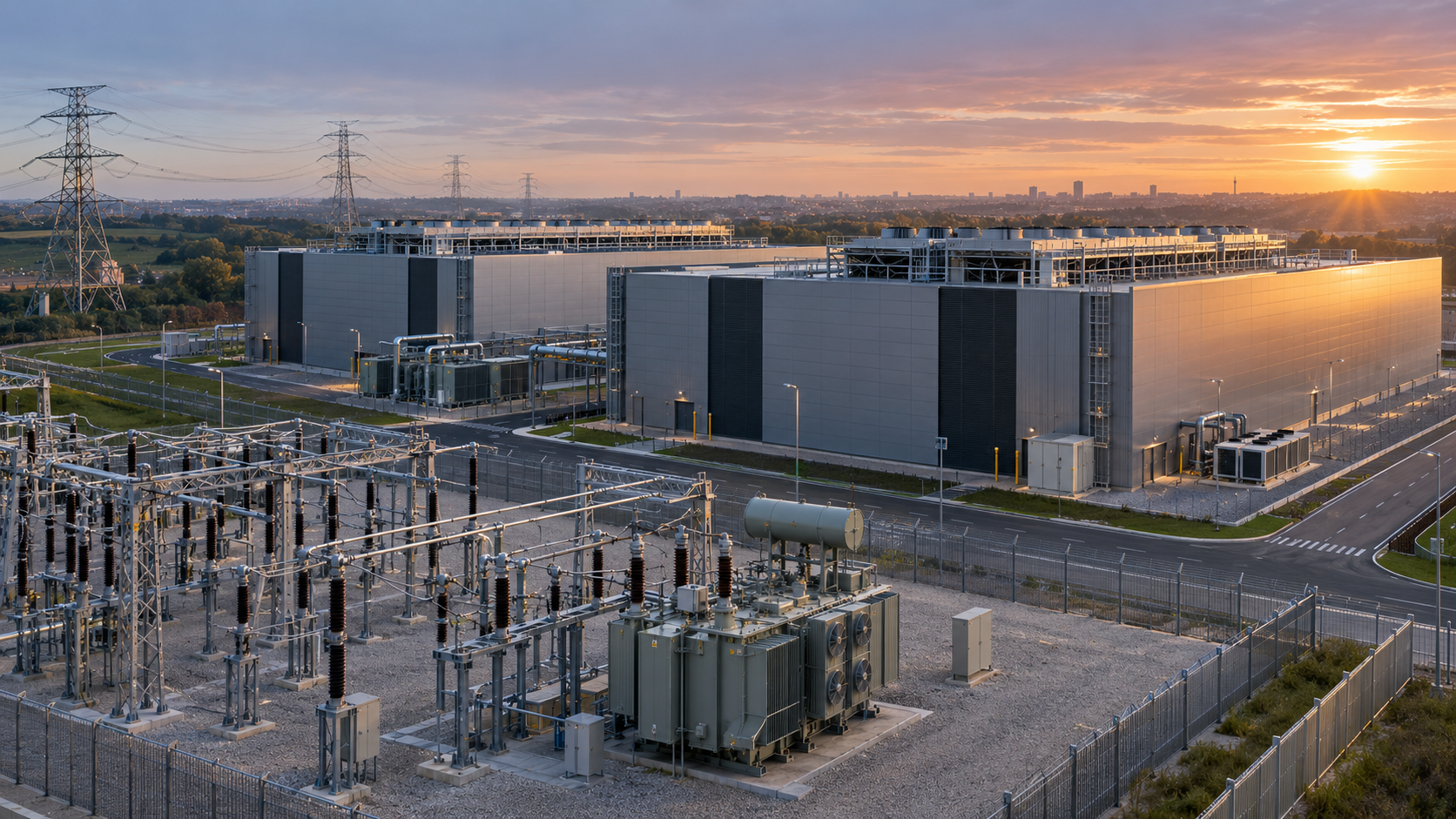
Two developments announced on 16 November reveal an increasingly differentiated investment model for digital infrastructure. Blackstone's proposed $5 billion AWS property transaction and Uniper's secured grid capacity illustrate how power access, physical assets and computing operations are becoming separate financing propositions. SMAM examines the implications for valuation, private capital, governance and long-term asset economics.
Two developments announced on 16 November illustrate a significant change in the financing of digital infrastructure. Blackstone has agreed to acquire a majority interest in a $5 billion portfolio of data-centre properties leased to Amazon Web Services, while European energy group Uniper is advancing data-centre opportunities supported by approximately 700 MW of secured grid capacity. Together, they demonstrate how electricity access, physical infrastructure and computing operations are becoming distinct investment propositions. For corporate owners and private-capital investors, the question is which risks belong in each part of the capital structure.
The expansion of artificial intelligence is changing the economics of physical infrastructure.
Although the commercial discussion frequently concentrates on processors, cloud services and the capabilities of advanced AI models, the development of large-scale computing depends on assets with considerably longer investment cycles.
Land, electricity connections, substations, cooling infrastructure and buildings must be secured before computing equipment can operate.
These components have different ownership characteristics, useful lives and financial risks.
On 16 November 2026, Blackstone Digital Infrastructure Trust announced a definitive agreement to acquire a 75% interest in two joint ventures with Amazon Web Services (AWS). The transaction values the underlying portfolio at approximately $5 billion, with an initial capitalisation rate of 7%.
The joint ventures will own 13 newly constructed data-centre powered shells across two campuses. AWS will retain a 25% ownership interest and lease the entire portfolio under triple-net arrangements for an initial 12-year term, potentially extendable to 32 years.
The transaction remains subject to closing conditions and is expected to complete in the fourth quarter of 2026. The $5 billion represents the announced transaction valuation, not necessarily the cash consideration payable for the 75% interest.
On the same day, European energy group Uniper presented its updated investment strategy, identifying approximately 700 MW of secured grid capacity for data-centre projects at an advanced stage of development.
Uniper is seeking to create additional value from existing industrial sites and electricity infrastructure across its European portfolio. The 700 MW figure represents secured capacity associated with development opportunities, not commissioned data-centre demand or completed facilities.
These announcements address different stages of the infrastructure investment process.
One concerns monetising completed, contractually occupied physical assets. The other concerns the commercial potential of existing energy infrastructure and development sites.
Together, they suggest that the data-centre industry is developing a more differentiated financing architecture.
The transaction terms and industry research cited below are sourced facts. The investment, valuation and governance implications represent SMAM analysis.
Electricity access is becoming a distinct source of asset value
The traditional valuation of industrial real estate has focused primarily on location, land characteristics, permitted use, construction quality and expected occupancy.
Data-centre development adds an increasingly consequential variable: access to reliable electricity at the required scale and within an economically viable timetable.
A suitable property may have limited commercial value as a data-centre location if obtaining an electricity connection requires several years of network reinforcement.
Conversely, an established industrial site with suitable grid infrastructure may offer advantages that cannot be replicated easily through new construction.
Uniper’s November announcement illustrates this opportunity.
The group has identified potential data-centre developments across its existing infrastructure portfolio, with approximately 700 MW of secured grid capacity already associated with advanced projects.
Uniper’s management also identified further potential across more than ten sites in Germany, the United Kingdom, Sweden and the Netherlands. These additional opportunities remain subject to site-specific development and commercial arrangements.
For owners of industrial assets, this changes the way underutilised infrastructure may be evaluated.
A former generation site can possess strategic attributes extending beyond its residual buildings or land value.
Existing electrical infrastructure, access roads, industrial zoning and proximity to transmission networks may reduce development expenditure or accelerate delivery.
However, grid capacity is not equivalent to unconditional operational readiness.
Its value depends on connection rights, technical availability, delivery schedules, regulatory requirements and the conditions under which those rights can be used or transferred.
For prospective investors, these distinctions should determine whether a site is valued as speculative development land, an advanced infrastructure project or an operational asset.
Physical ownership is becoming separable from computing operations
Blackstone’s proposed transaction illustrates a different development.
The assets being acquired are newly constructed powered shells: buildings and associated infrastructure designed to accommodate data-centre operations.
They are not equivalent to purchasing the underlying computing businesses, processors or cloud-service revenues.
AWS will remain the tenant and retain a minority equity interest in the joint ventures.
Under the announced triple-net leases, the tenant will carry substantial property-related operating obligations, consistent with the contractual arrangements disclosed by Blackstone.
This creates an investment proposition whose financial performance is primarily associated with rental contracts, counterparty creditworthiness and the value of the underlying real estate.
Blackstone reports an initial capitalisation rate of 7%. That is a property-income valuation metric, not a guaranteed investor return, a financing yield or evidence of future investment performance.
The distinction is economically important.
Computing hardware may experience relatively rapid technological obsolescence.
A properly located, designed and maintained data-centre property can have a substantially longer economic life.
Separating ownership of the building from ownership of the computing equipment allows capital providers to assume different categories of risk.
Real-asset investors can focus on contractual property income and residual asset value.
Technology operators can retain control over computing capacity, equipment investment and customer relationships.
Nevertheless, the separation is not absolute.
A building’s long-term value still depends on its technical suitability, electricity access and ability to accommodate evolving computing requirements.
The investor may avoid direct exposure to processor replacement costs while retaining exposure to the consequences of technological change for its property.
Contractual income determines whether infrastructure becomes financeable
The financial attractiveness of data-centre real estate depends on the quality of the contracts supporting its cash flows.
A fully leased building with an established tenant may present a different financing profile from an otherwise similar facility being constructed without committed occupancy.
The Blackstone–AWS arrangement demonstrates the importance of this distinction.
The announced leases cover the entire portfolio, with a 12-year initial term and extension provisions that could increase the contractual relationship to 32 years.
AWS’s continued minority ownership also establishes a continuing economic relationship with the properties.
These characteristics may support financing visibility and alignment between property owner and operating tenant.
However, extension provisions should not be treated as guaranteed occupancy beyond the initial contractual period.
Likewise, even a financially established tenant introduces concentration exposure when it accounts for all the rental income.
For lenders, the underwriting analysis must extend beyond the identity of the occupier.
It should assess the enforceability of rental obligations, termination provisions, maintenance responsibilities, permitted modifications and the treatment of the asset if the tenant vacates.
For shareholders, the relationship between contractual rental income and future capital expenditure is equally important.
Data-centre facilities may require electrical, cooling or connectivity upgrades to remain commercially relevant.
The allocation of those costs between landlord and tenant can materially affect investment returns.
The underlying financing principle is familiar from other infrastructure sectors.
Contracts can transform an asset’s risk profile, but their financial value depends on the obligations they actually establish.
Development capacity should not be confused with bankable capacity
The distinction between an identified development opportunity and an operating investment is particularly important in a market experiencing substantial demand growth.
According to CBRE’s June 2026 Global Data Center Trends report, installed inventory across 16 major markets reached approximately 16 GW in the first quarter of 2026, representing annual growth of 25%.
Despite this expansion, average vacancy declined to 6.7%, compared with 8.3% a year earlier.
CBRE also identified electricity availability and grid infrastructure as important constraints on development. These figures describe its selected major markets, not the entire global data-centre industry.
Strong demand can therefore coexist with considerable execution risk.
A proposed facility may have identified customers without possessing a deliverable electricity connection.
Another may have secured land and power capacity but still face construction, environmental, planning or equipment procurement constraints.
The International Energy Agency’s April 2026 Key Questions on Energy and AI report identifies these bottlenecks as central to the sector’s development.
The IEA projects global data-centre electricity consumption to increase from approximately 485 TWh in 2025 to 950 TWh in 2030 under its central scenario. It also warns that capital-market conditions, grid constraints and equipment availability may prevent portions of the announced project pipeline from materialising.
For infrastructure investors, this creates a clear requirement to differentiate development milestones.
Secured land, conditional grid access, construction completion, commissioning and contracted occupancy represent distinct stages of investment readiness.
They should not command equivalent valuations or support identical debt structures.
A credible financing strategy should connect each capital commitment to the technical and commercial risks remaining at that stage.
Capital structures can separate development, property and operating risks
As the data-centre sector matures, ownership structures can be designed around the economic characteristics of individual assets.
An energy group may control an industrial location and grid infrastructure.
A development company may undertake planning, engineering and construction.
A real-asset investor may own the completed property.
A hyperscale operator may lease that infrastructure while financing its own computing equipment and commercial operations.
These responsibilities can be combined within one organisation or distributed among several entities.
The appropriate arrangement depends on capital availability, commercial objectives and the parties’ willingness to assume different risks.
For established industrial groups, monetising an underutilised site through a sale, long lease or development partnership may release economic value without requiring the company to become a data-centre operator.
For infrastructure investors, acquiring completed facilities with contracted occupancy may provide exposure to digital infrastructure without undertaking the full development process.
For technology operators, sale-and-leaseback arrangements can release capital tied up in property assets while retaining operational access to strategically important facilities.
However, the financing benefits must be assessed against long-term contractual commitments and the loss of direct property ownership.
The structure may also create additional governance requirements.
Joint-venture agreements must establish responsibility for major capital expenditure, financing decisions, operational changes and potential future disposals.
In cross-border arrangements, ownership, taxation, security interests and cash distribution may be governed by different jurisdictions.
These elements influence the economic flexibility available to shareholders throughout the investment period.
The objective should be to allocate each risk to the party best equipped to manage it, rather than simply maximise the amount of external capital introduced into the structure.
The investment case must survive changes in technology and demand
The expansion of AI-related infrastructure is creating substantial opportunities across real estate, power generation, electrical engineering and industrial services.
Nevertheless, current demand should not be extrapolated indefinitely.
The IEA notes that future electricity requirements remain sensitive to technological efficiency, model adoption and the ability of energy systems to accommodate additional demand.
Its 2026 research also identifies emerging concerns about electricity affordability, permitting and the social acceptance of data-centre development.
These uncertainties have different implications across the capital structure.
A computing operator faces the risk that investment in equipment becomes economically outdated.
A property owner faces the risk that its building becomes less attractive to future occupiers.
An energy infrastructure provider faces the possibility that anticipated electricity demand does not emerge at the expected location or on the expected timetable.
For private-capital investors, these exposures should be evaluated independently.
Long-term leases, strong tenant covenants and existing electricity infrastructure can reduce particular risks without eliminating the underlying dependence on sustainable digital demand.
Downside analysis should therefore consider tenant concentration, re-leasing costs, equipment-related building upgrades, residual asset value and the financial consequences of delayed commissioning.
For mid-market companies, the most accessible opportunities may lie in specialised activities supporting the industry’s physical development: electrical systems, industrial automation, cooling equipment, engineering services and infrastructure maintenance.
Participation in those markets still requires commercial discipline.
A growing customer segment does not justify unlimited production capacity or working-capital commitments.
The relevant investment proposition depends on contractual demand, achievable margins and the resilience of the underlying business if development schedules change.
SMAM Perspective
The announcements by Blackstone and Uniper on 16 November illustrate a meaningful evolution in the relationship between technology investment and physical infrastructure ownership.
Electricity access, industrial sites, purpose-built facilities and computing operations can increasingly be evaluated as separate economic activities.
For corporate owners, this creates opportunities to reassess the value of existing infrastructure and develop partnership structures aligned with their financial and operational capabilities.
For infrastructure funds and family offices, it offers different forms of exposure to digital development, from contracted property income to development-stage capital.
For lenders and institutional investors, the central challenge is to distinguish secured contractual cash flows from anticipated future demand.
The long-term value of data-centre infrastructure will depend not simply on the computing capacity it can accommodate, but on the legal rights, physical availability and contractual revenues that make that capacity economically sustainable.
As the sector develops, the quality of the capital structure may prove as important as the scale of the investment.