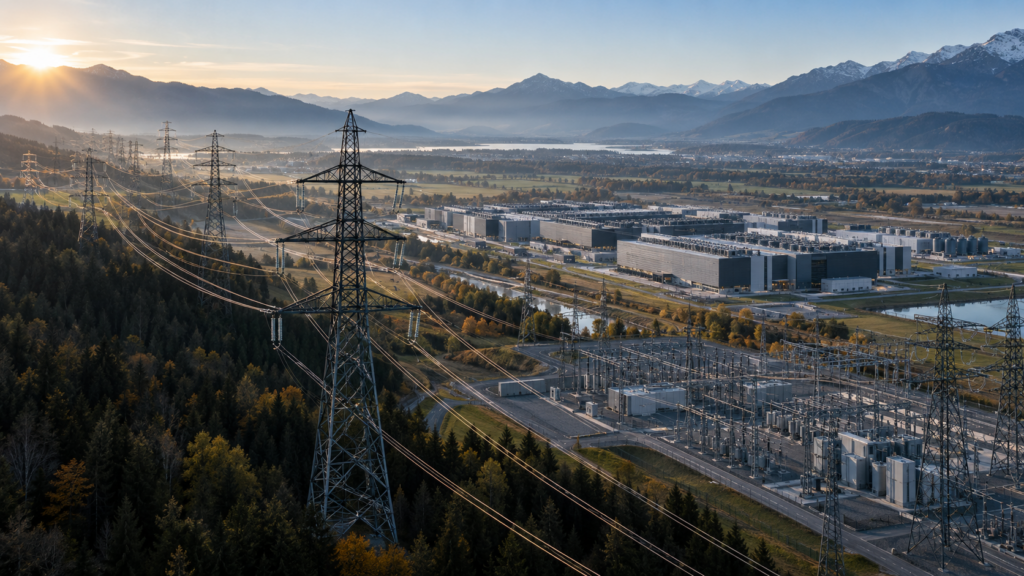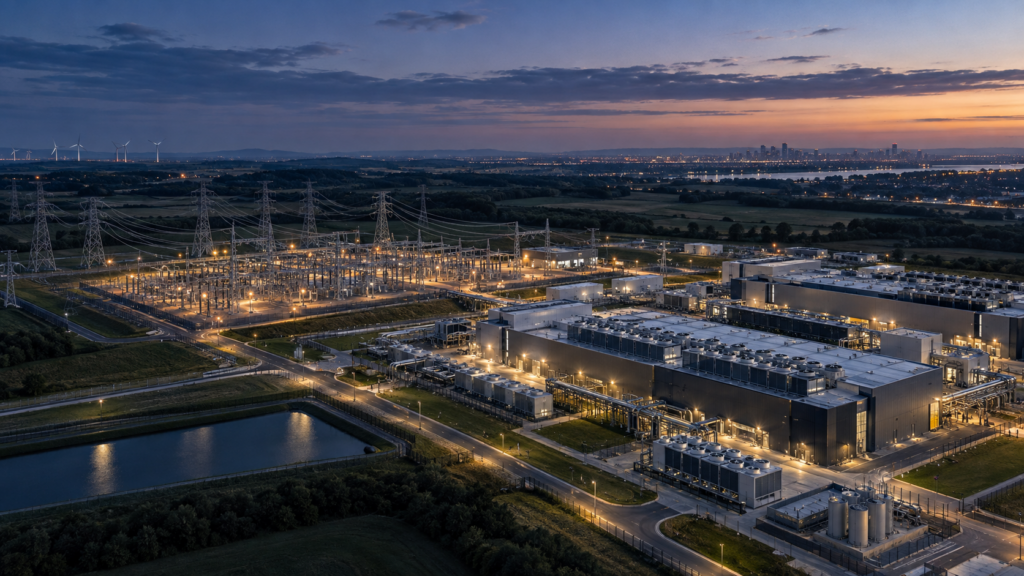
Artificial intelligence is still discussed primarily as a technology race: better models, faster chips, more capable agents and greater access to power. Increasingly, however, the economics of the sector point to a second race running in parallel — a race to build the financing architecture capable of supporting the physical infrastructure behind those technologies.
The scale is beginning to change the nature of the problem. Data centres, accelerated-computing clusters, grid connections, cooling systems and long-dated energy commitments require capital on a level that cannot be treated as a conventional technology capex programme. This week, the Financial Times reported that large technology groups are using residual-value guarantees and special-purpose structures to support what could amount to as much as $300 billion of AI-related exposure outside their core balance sheets. In August, NVIDIA announced memoranda of understanding with Apollo, BlackRock, Blackstone, Brookfield, Goldman Sachs and KKR aimed at mobilising more than $500 billion of third-party capital for AI infrastructure over time.
These are not marginal financing techniques attached to an otherwise unchanged industry. They indicate that the AI buildout is becoming an exercise in ownership design, contractual risk transfer and balance-sheet optimisation. The strategic question is therefore widening. It is no longer only who can secure the best compute. It is who can finance that compute at scale, retain the right degree of control and place the residual risk with investors capable of absorbing it.
- AI is moving from a software-led investment narrative to a capital-intensive infrastructure cycle.
- Balance-sheet capacity is becoming a strategic constraint even for the largest technology groups.
- Joint ventures, project debt, leases and SPVs can separate operational control from asset ownership.
- Off-balance-sheet structures redistribute and reprice risk; they do not eliminate economic exposure.
- Private capital is becoming an integral part of the AI industrial system.
- Capital architecture should be designed alongside operating strategy, not after it.
From a Software Narrative to an Infrastructure Cycle
The first phase of the generative-AI boom was easy to describe in software terms. Competitive advantage appeared to sit primarily in models, data, developer ecosystems and semiconductor performance. The next phase is more physical. Compute must be housed, powered, cooled, connected and renewed. Every layer introduces an asset base, a counterparty relationship and a financing requirement.
That shift matters because physical infrastructure behaves differently from software. It has construction risk, utilisation risk, energy risk, asset-duration risk and, in some cases, material residual-value risk. It also requires capital before revenues are fully visible. PIMCO noted this month that the AI capex funding gap is likely to persist and that the financing chain is broadening from hyperscaler corporate debt to hyperscaler-tenanted data centres, neocloud infrastructure and more specialised forms of credit.
The implication is straightforward: as AI becomes more capital intensive, financing ceases to be a back-office consequence of strategy. It becomes part of the strategy itself. The pace at which capacity can be brought online will increasingly depend on the depth, cost and structure of the capital available to finance it.
The Balance Sheet Is Becoming a Strategic Constraint
Even the largest technology companies operate under balance-sheet constraints. Capital committed to AI infrastructure competes with acquisitions, shareholder distributions, research and development, credit ratings and the financial flexibility required to respond to the next technology cycle. The issue is not whether hyperscalers can borrow. It is whether owning and financing every asset directly is the most efficient use of corporate capital.
This is where a distinction between control and ownership becomes economically important. A company may need secure, long-duration access to compute without needing to own 100% of the underlying real estate, power infrastructure or equipment. Long-term leases, capacity commitments, project-level debt and joint ventures can preserve operational access while allowing third-party investors to own or finance part of the asset base.
That architecture is familiar in other capital-intensive sectors. Airlines separate aircraft use from aircraft ownership. Energy companies develop projects through ring-fenced vehicles. Telecom operators have monetised towers while retaining network access. What is new is the speed and scale at which similar principles are being applied to AI infrastructure — and the increasingly sophisticated way in which technology, real assets and private credit are being combined.
The AI SPV Is Becoming an Industrial Financing Tool
Meta’s El Paso transaction with BlackRock illustrates the direction of travel. The venture is structured with funds managed by BlackRock owning 80% and Meta retaining 20%. The parties have committed to fund approximately $14 billion of development costs, with a portion of BlackRock’s investment supported by $12.5 billion of debt financing. Meta will lease the entire campus and has also provided residual-value guarantees with an aggregate threshold of approximately $13 billion that declines over time.
The economic logic is more important than the labels. Meta secures access to a one-gigawatt campus and retains operating involvement without funding the entire asset base directly. Infrastructure investors gain exposure to a long-lived asset with an investment-grade technology tenant and contractual support. Debt investors receive a financing proposition supported by leases, asset value and sponsor-linked protections. The project vehicle sits between those interests and converts a very large corporate infrastructure requirement into a financeable asset-level structure.
Meta used a related architecture for its Hyperion campus with Blue Owl Capital, where the investment manager owns 80% of a joint venture with approximately $27 billion of development costs and Meta retains 20%, alongside operating leases and a residual-value guarantee. The repetition matters. It suggests that these structures are moving from exceptional transactions toward a more repeatable financing model for the AI infrastructure cycle.
Off-Balance-Sheet Does Not Mean Off-Risk
Financial engineering can redistribute risk. It cannot eliminate it.
The attraction of special-purpose vehicles is obvious: they can isolate assets, broaden the investor base, create project-level leverage and reduce the amount of corporate capital tied up in infrastructure. But legal separation should not be confused with economic risk transfer.
A long-term lease, purchase obligation, capacity payment or residual-value guarantee can reconnect the sponsor to the economics of the asset even when the debt itself sits elsewhere. If future utilisation disappoints, if hardware depreciates faster than expected or if the asset becomes less valuable at the end of a lease period, the question becomes which party absorbs the shortfall. In other words, the structure can move risk, tranche it and reprice it; it does not make it disappear.
This distinction is becoming increasingly relevant as investors analyse the true leverage embedded in the AI buildout. The Financial Times’ reporting this week on residual-value guarantees reflects precisely that concern: creditors and rating analysts are looking beyond accounting presentation to the contingent obligations that may remain with technology sponsors. The correct analytical question is therefore not whether an exposure is on or off balance sheet. It is which risks have genuinely been transferred, which have merely been transformed and which ultimately remain economically linked to the sponsor.
Private Capital Is Becoming Part of the AI Industrial System
The financing ecosystem developing around AI is also changing the role of private capital. Large asset managers are no longer simply providing incremental debt alongside public markets. They are increasingly becoming long-term infrastructure partners, structuring capital pools around data centres, compute equipment, energy and contracted usage.
NVIDIA’s proposed financing platforms with six major financial groups are a particularly clear signal. The ambition to mobilise more than $500 billion of third-party capital is effectively an attempt to turn compute into a scalable investable asset class, connecting the semiconductor ecosystem with infrastructure equity, private credit and institutional savings. If successful, that would expand the capacity of the financial system to fund AI without forcing the entire burden onto hyperscaler corporate balance sheets.
This is also becoming a question of regional competitiveness. Apollo recently highlighted that U.S. data-centre debt securitisations totalled $18 billion in the first half of 2026, compared with only $0.9 billion in the European Union. The point is broader than securitisation itself. Regions seeking to build sovereign or domestic AI capacity need not only power, land and technology policy; they also need financing markets capable of absorbing large, long-duration infrastructure risk. Capital-market architecture is becoming part of industrial policy.
The Strategic Lesson Extends Well Beyond Big Tech
The relevance of these structures is not that mid-market companies should attempt to replicate hyperscaler financing. The lesson is more fundamental: once growth becomes capital intensive, operating strategy and capital structure should be designed together.
Management teams should determine which assets are strategically essential to own and which can be accessed through contractual control. They should distinguish corporate risk from project risk, match financing duration to asset life, and avoid using scarce equity to fund assets that may be capable of supporting dedicated debt or infrastructure capital. Where international expansion is involved, local vehicles can also separate jurisdictional, regulatory and partner risk from the core group without fragmenting strategic control.
The sequencing is equally important. A project may become financeable only after land, power, offtake, permits or anchor customers have reduced specific risks. Raising the wrong capital before those milestones are achieved can be expensive; structuring the project so that each risk is financed by the capital best suited to bear it can materially change the economics. This is the same principle now visible in AI at extraordinary scale: capital architecture is not an administrative layer placed beneath growth. It is one of the mechanisms that makes growth executable.
Selected Sources
- Financial Times — Big Tech Uses Guarantees to Keep $300bn of AI Exposure Off Balance Sheets
- NVIDIA — Financing Platforms to Mobilise Over $500bn of Third-Party Capital for AI Infrastructure
- Meta — Strategic Venture With BlackRock for the El Paso Data-Centre Campus
- PIMCO — The Credit Market Lens: One AI Trade for Now, Many Trades Later
- Apollo — Europe’s AI Buildout Is Missing a Financing Market
Related Insight
The AI infrastructure cycle is revealing a broader principle of corporate finance. When the scale of investment changes, the financing model must often change with it. Ownership, control, funding and risk do not need to sit in the same place — but they do need to be deliberately aligned.
For boards and management teams, the critical question is therefore not simply how much capital can be raised. It is which balance sheet should carry which asset, which investor should carry which risk, and which contractual commitments are necessary to preserve strategic control without recreating the same exposure elsewhere.
The companies best positioned to scale capital-intensive growth will increasingly be those that treat capital architecture as a strategic capability rather than a financing afterthought. AI is making that lesson visible at unprecedented scale. It will not remain confined to technology.