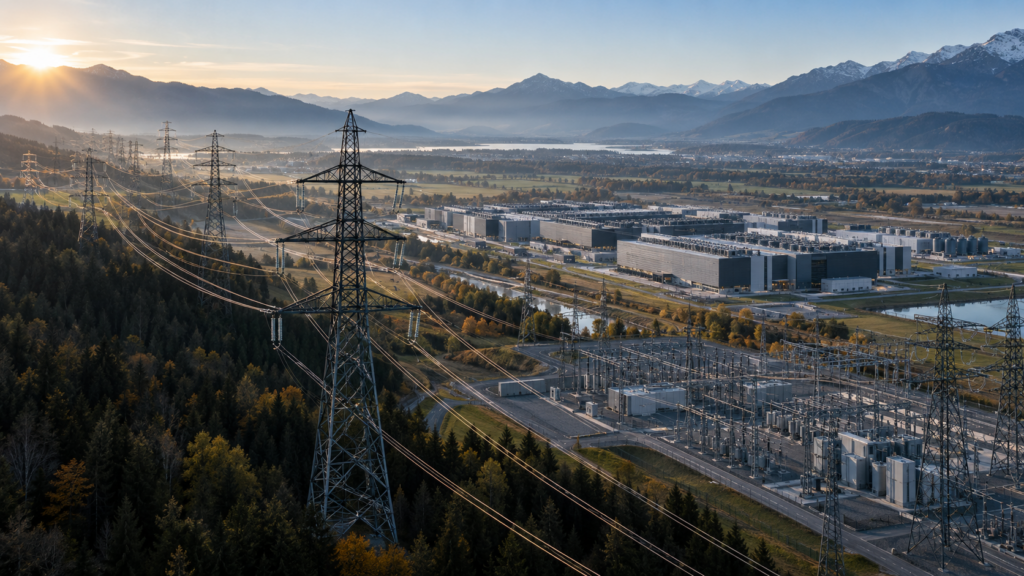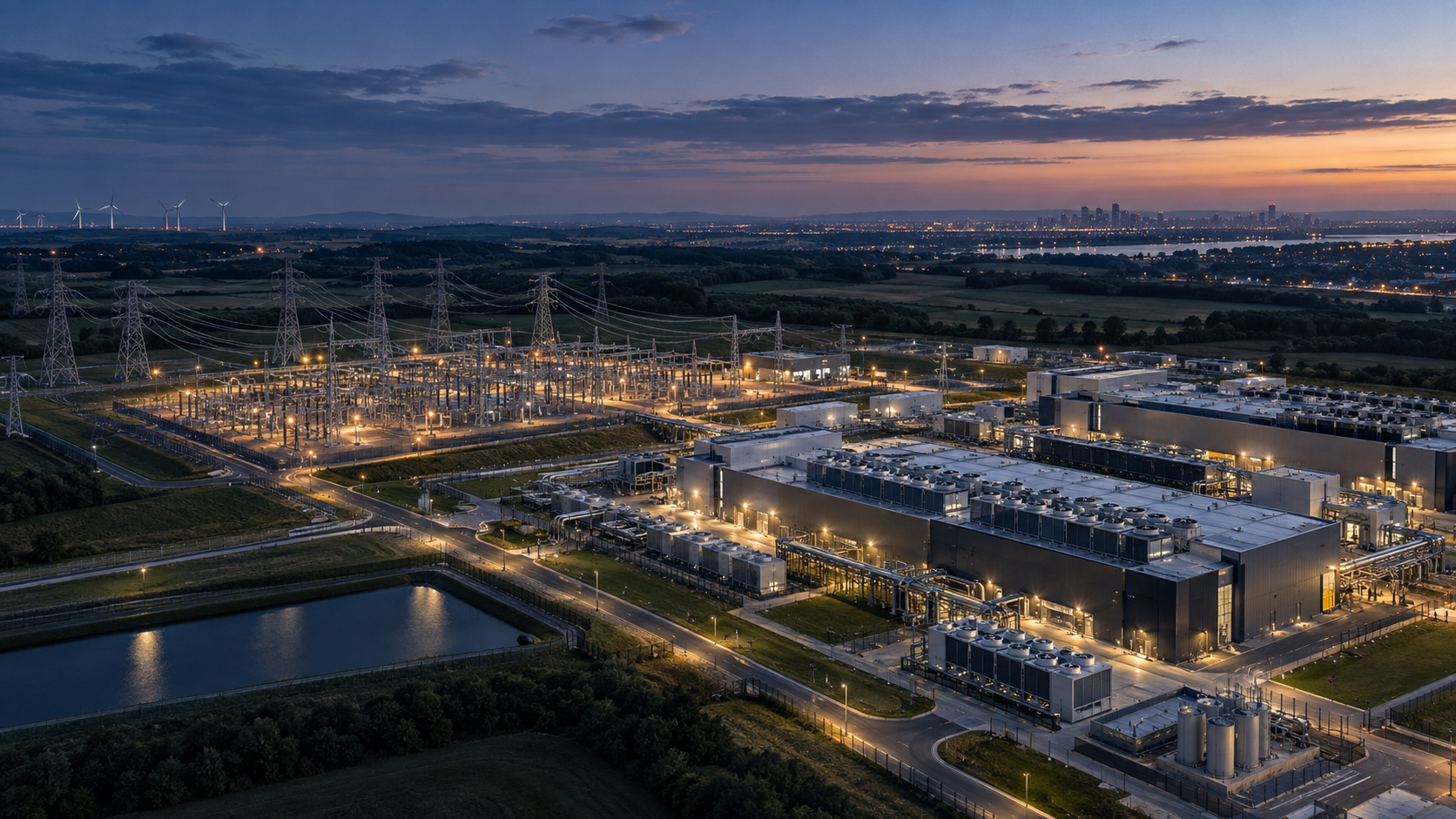
Artificial intelligence is often discussed as a race for computing power. Increasingly, however, the ability to deploy that computing power is being determined elsewhere: by the grid, energy availability, cooling and water systems, land, permitting, connectivity and the resilience of surrounding infrastructure.
The World Economic Forum’s newly published Data Centre Sustainability and Resilience decision playbook captures the scale of the shift. By 2030, global data-centre investment could reach $7 trillion, while sector electricity demand is expected to grow by at least 20% annually.
This changes the investment case. A data centre is no longer simply a technology asset housed inside real estate. It is becoming an integrated infrastructure platform — with significant consequences for developers, investors and capital providers.
- AI infrastructure growth is increasingly constrained by physical systems: grids, energy, cooling, water, land, permitting and connectivity.
- The IEA expects global data-centre electricity consumption to more than double from around 415 TWh in 2024 to approximately 945 TWh by 2030.
- Time-to-power is becoming time-to-revenue and should be treated as a core financing variable, not merely an engineering workstream.
- Sustainability and resilience increasingly affect operating economics, scalability, permitting and bankability.
- Capital architecture should follow the project’s risk architecture, financing a sequence of de-risking events rather than a single undifferentiated exposure.
- Infrastructure certainty may become one of the sector’s most valuable competitive advantages.
AI Infrastructure Is Becoming a Physical Infrastructure Challenge
The extraordinary growth of artificial intelligence is creating demand for data centres at a pace that the underlying physical infrastructure was not necessarily designed to absorb.
The International Energy Agency expects global data-centre electricity consumption to rise from around 415 TWh in 2024 to approximately 945 TWh by 2030 in its base case. More importantly, the impact is highly concentrated geographically: individual facilities can create industrial-scale loads in specific locations, placing pressure on grids that often require substantially longer development cycles than the assets they are expected to serve.
That timing mismatch matters.
A data centre can be designed and built relatively quickly. Transmission infrastructure, substations, generation capacity and permitting processes often cannot.
This creates a fundamental tension between the speed of digital demand and the speed of physical infrastructure delivery.
The strategic question is therefore shifting. It is no longer simply:
Where is demand for compute?
It is increasingly:
Where can compute actually be delivered — at scale, on time and with sufficient resilience?
That second question is becoming materially more important to underwriting.
Power Is No Longer an Operating Assumption
Historically, access to electricity could often be treated as one of several inputs to a data-centre investment case. That is becoming increasingly difficult.
Power availability is now moving much closer to the centre of the investment thesis. The issue is not simply whether electricity exists. Investors increasingly need to understand:
- how much capacity is genuinely available;
- when that capacity can be delivered;
- whether it is firm or conditional;
- how the project is connected to the grid;
- what redundancy exists;
- how energy will be priced and how volatile that pricing may be; and
- what happens if future expansion requires materially more capacity.
This is where the distinction between power availability and time-to-power becomes critical.
A project may have access to land, demand and technology, but if reliable power cannot be secured within the required development window, the economics of the entire asset can change.
Revenues are delayed. Construction sequencing becomes more complex. Financing periods lengthen. Customer commitments become harder to convert. The cost of carrying development risk increases.
The IEA estimates that, unless grid constraints are addressed, around 20% of planned data-centre capacity could face connection delays.
Power should therefore no longer be considered simply an engineering workstream.
It is a financing variable.
Sustainability Is Becoming Part of Bankability
The same evolution is taking place around sustainability.
For years, sustainability in data centres was discussed primarily through an ESG lens. That remains relevant. But the more consequential shift is economic.
Energy efficiency, cooling architecture, water consumption, heat reuse, power sourcing and infrastructure density increasingly affect not only environmental performance, but also operating costs, capacity utilisation, permitting, scalability and long-term asset value.
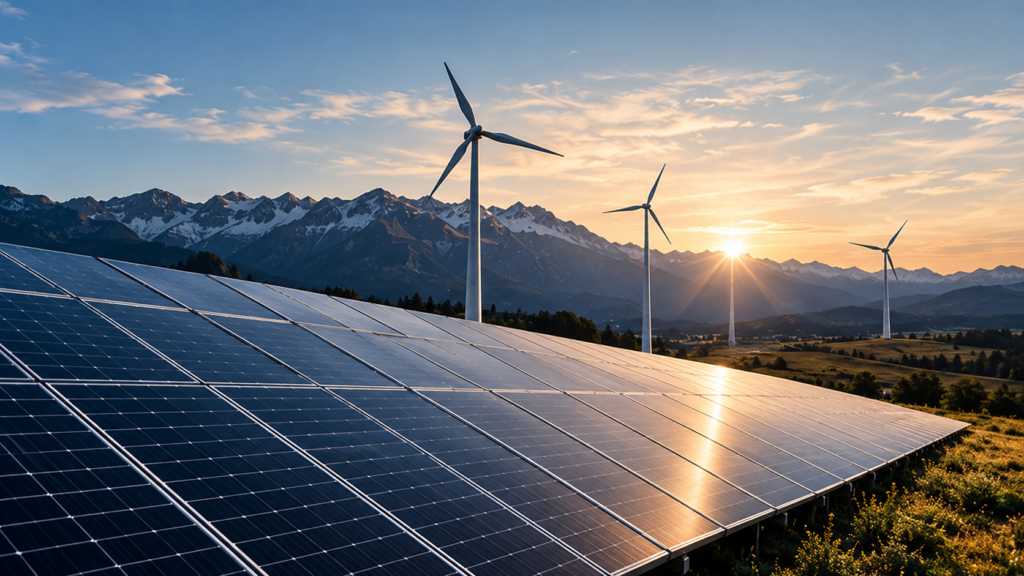
The World Economic Forum’s decision playbook highlights liquid cooling, heat reuse, renewable-energy co-location and optimisation systems as increasingly relevant to the next generation of data-centre development.
The significance of these technologies goes beyond sustainability metrics. They can affect the economics of the facility itself.
- A more efficient cooling architecture may support higher compute density.
- A more resilient energy strategy may reduce exposure to grid constraints.
- Water-efficient systems may improve development feasibility in resource-constrained regions.
- Heat recovery may change the relationship between a facility and its surrounding community.
- Energy sourcing may affect both operating costs and permitting outcomes.
What was previously treated as an ESG overlay is increasingly becoming part of the operating model and the financing case.
Sustainability should therefore be considered through the lens of bankability — not because every sustainable project is automatically financeable, but because resource efficiency, resilience and infrastructure design can materially change the asset’s risk profile.
Resilience Must Be Engineered as a System
For a modern data centre, resilience cannot be reduced to backup generation or redundant servers. The infrastructure is becoming too interconnected.
A genuinely resilient platform must consider multiple dependencies simultaneously:
Energy resilience
Can the facility continue operating through grid disruption or volatility?
Cooling resilience
Can thermal performance be maintained as power density increases?
Water resilience
Is the operating model compatible with local resource availability?
Connectivity resilience
Are network routes and telecommunications sufficiently redundant?
Supply-chain resilience
Can critical components, transformers, cooling systems and power electronics be sourced within acceptable timeframes?
Cyber resilience
Are both the digital systems and the physical energy infrastructure supporting the facility adequately protected?
The World Economic Forum has highlighted the growing interdependence between data centres and energy systems, noting that resilience increasingly requires coordinated cybersecurity and monitoring across both.
This matters because data centres are no longer isolated consumers of infrastructure. At scale, they become part of the infrastructure system itself. The Forum has argued that AI infrastructure increasingly displays characteristics of critical infrastructure, given its capital intensity, energy dependence and growing importance to economic activity.
That has implications not only for operations, but also for investment underwriting.
The Capital Architecture Should Follow the Risk Architecture
Perhaps the most important consequence of this shift is financial.
A large-scale data-centre development does not represent a single risk. It represents a sequence of risks:
- land risk;
- permitting risk;
- grid-connection risk;
- energy-procurement risk;
- construction risk;
- technology risk;
- customer risk;
- operating risk; and
- eventual refinancing and exit risk.
Treating all of those exposures as though they should be financed by the same capital is rarely optimal.
The financing architecture should evolve as the project becomes progressively de-risked.
In the earliest stages, capital is absorbing uncertainty. Land may still need to be secured. Permits may remain conditional. Power may not yet be fully contracted. Customer demand may be prospective rather than binding. At that stage, the risk profile is fundamentally different from that of an operating facility with contracted capacity, proven infrastructure and visible cash flows.
As those risks are resolved, the capital universe can change. Longer-duration or lower-cost capital may become accessible. Infrastructure investors may become relevant. Debt capacity can increase. Refinancing options can broaden.
A data centre should not be financed as a single risk. It should be financed as a sequence of de-risking events.
This is where capital strategy becomes inseparable from development strategy.
The relevant question is not simply how much capital the project requires. It is which capital should finance which risk, and at what point in the project’s evolution.
Time-to-Power Is Becoming Time-to-Revenue
For developers and investors, one metric deserves particular attention: time-to-power.
It increasingly determines time-to-revenue.
A facility that secures customers but cannot energise capacity remains unable to monetise that demand. A project with excellent technical specifications but uncertain grid access remains difficult to underwrite. A development that requires repeated redesign because energy, cooling or resource constraints were addressed too late may destroy value before operations begin.
This is precisely why the WEF playbook argues for embedding sustainability and resilience earlier in the development process: doing so can improve capital decisions, reduce redesign risk and preserve strategic flexibility.
From a financing perspective, the implications are clear. The earlier a developer can convert critical dependencies into evidence, the earlier those dependencies can begin to move from risk to underwriting input.
- Power agreements
- Grid studies
- Permitting pathways
- Customer commitments
- Cooling design
- Water strategy
- Contractual risk allocation
Each can reduce uncertainty. And reducing uncertainty is what progressively expands the available capital pool.
From Data-Centre Project to Investable Infrastructure Platform
The transition can be framed relatively simply:
| Development question | Investor question |
|---|---|
| Is land available? | Is the site legally and operationally secured? |
| Is power nearby? | How much capacity is contracted, by when and under what terms? |
| Is there market demand? | How much capacity is contracted or supported by credible customers? |
| Is the technology viable? | Is the technical architecture proven at the required scale? |
| Can the facility be built? | Which development and construction risks remain unresolved? |
| Is the project sustainable? | How do energy, water and cooling choices affect economics and scalability? |
| Is the data centre resilient? | How does the asset perform under power, cyber, supply or infrastructure disruption? |
| How much capital is required? | Which capital should fund each stage of risk? |
| What is the valuation? | What evidence supports the risk-adjusted return? |
That transition is central.
A project becomes more investable not when the narrative becomes more ambitious, but when the evidence becomes more robust.
Sustainability, Resilience and Finance Are Converging
The broader implication is that sustainability, resilience and financing can no longer be treated as separate workstreams. They increasingly converge in the same underwriting decision.
Energy strategy affects operating economics. Water strategy affects development feasibility. Cooling affects power density. Grid access affects delivery schedules. Resilience affects customer confidence. Permitting affects time-to-market. All of those variables eventually affect the cost, availability and structure of capital.
This is why the next generation of data-centre development will require much closer integration between technology, energy, infrastructure and finance.
The companies that succeed will not necessarily be those with the largest development pipelines. They will be those capable of demonstrating that those pipelines can actually be delivered.
The Next Competitive Advantage May Be Infrastructure Certainty
AI demand is unlikely to disappear. But abundant demand does not automatically create abundant investable projects.
That distinction will become increasingly important as capital providers become more selective about where they take development and infrastructure risk.
In that environment, infrastructure certainty may become one of the most valuable competitive advantages — not certainty in an absolute sense, but sufficient certainty around power, timing, customers, permitting, resilience, capital requirements and risk allocation.
The projects that can establish those elements early will not simply be easier to build. They may also be easier — and potentially cheaper — to finance.
That is where the debate around AI infrastructure is moving: beyond compute, beyond real estate and beyond sustainability as a reporting exercise.
Toward an integrated question of execution and investability.
At SMAM, we view data-centre development through an integrated strategic and capital lens.
The growth of artificial intelligence is creating extraordinary demand for digital infrastructure, but the investment case increasingly depends on the physical systems that sit beneath it: energy, grid access, cooling, water, connectivity, resilience and the capital structures used to finance them.
For developers and investors alike, the challenge is therefore not only to identify demand. It is to convert infrastructure complexity into an opportunity that can be structured, underwritten and financed.
That requires development sequencing, evidence, risk allocation and capital architecture to be considered together.
Compute creates demand.
Infrastructure determines execution.
Structure determines investability.