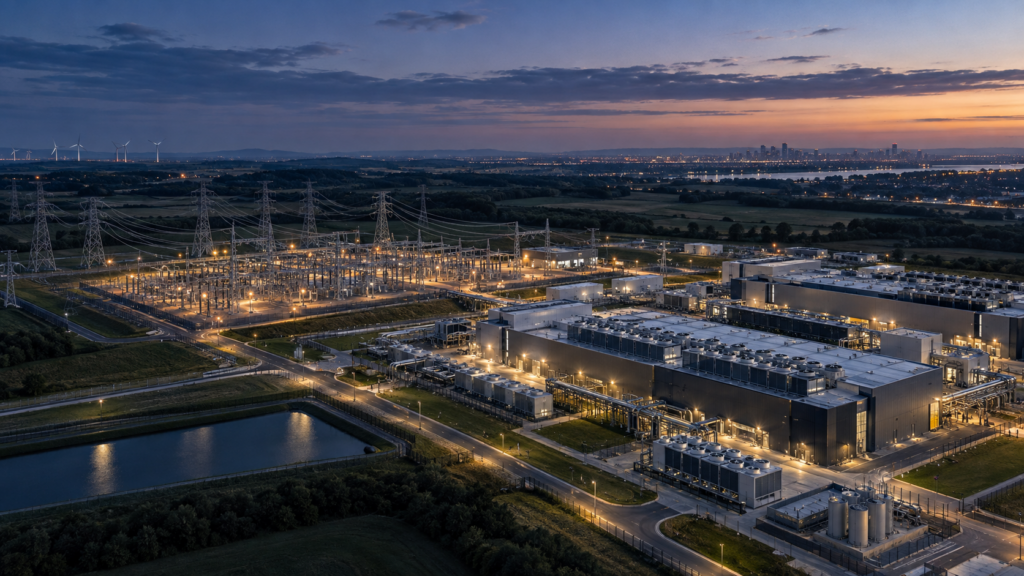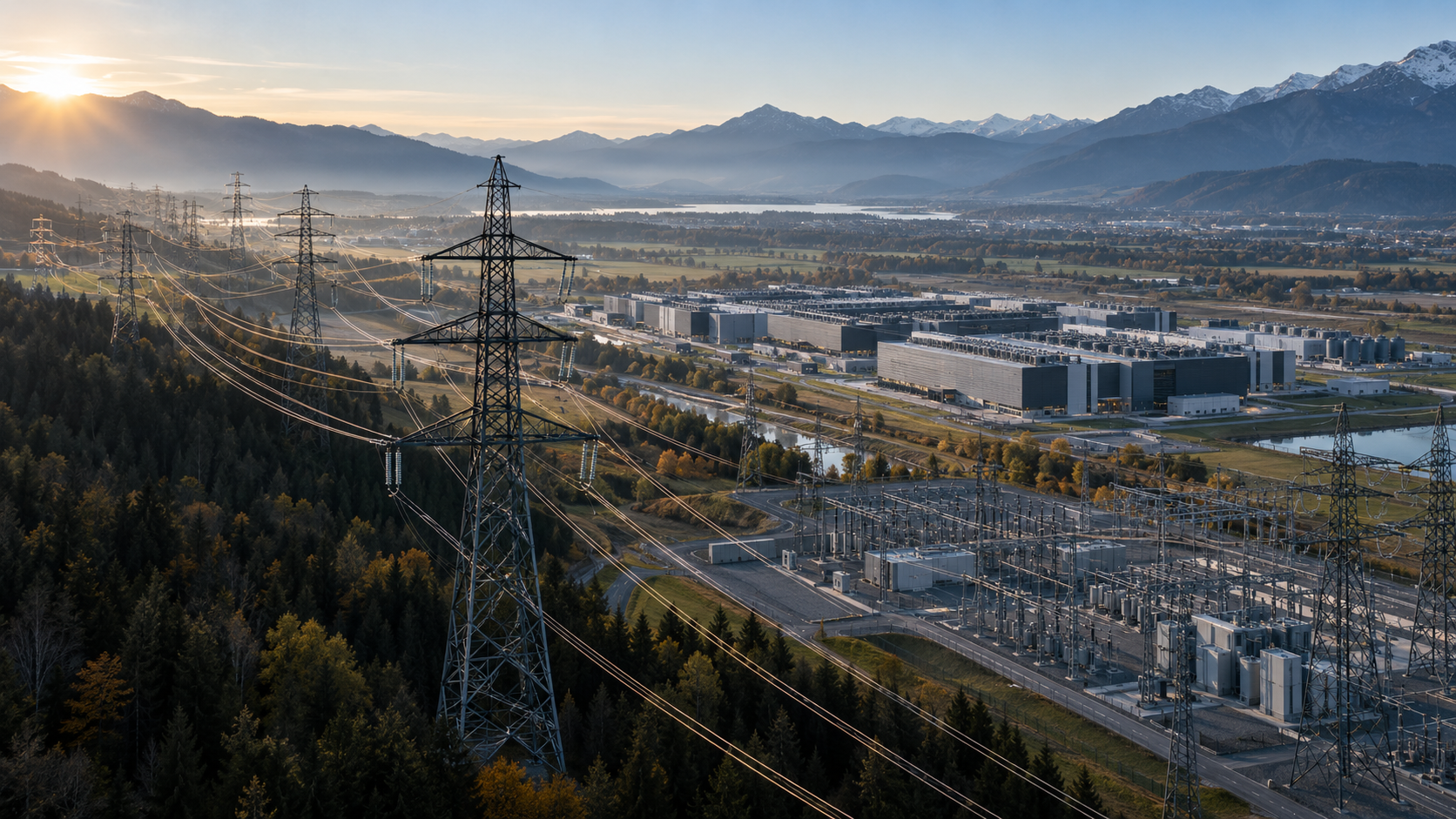
For much of the energy transition, the central question was whether enough electricity could be generated.
That question is no longer sufficient.
As electricity demand expands across data centres, advanced manufacturing, industrial electrification, mobility and other capital-intensive sectors, a second constraint is becoming increasingly important: whether that electricity can actually be delivered, where it is needed, when it is needed and at the required scale.
The distinction is becoming economically significant.
The International Energy Agency now describes grid capacity as a critical bottleneck in many regions. More than 2,500 GW of generation, storage and large-load projects are estimated to be waiting in connection queues globally, while annual investment in electricity grids would need to rise by roughly 50% from today’s approximately $400 billion level by 2030 to support expected demand growth.
This week has reinforced the direction of travel. The IEA published a new report focused specifically on extracting more capacity from existing networks through digitalisation and AI. Two days later, the European Investment Bank announced €19 million of financing for Reactive Technologies, whose grid-monitoring platform is designed, among other things, to facilitate the integration of renewables and large consumers such as data centres. On 24 September, the European Commission published the conditions for a new €1 billion industrial heat decarbonisation auction, with electrification among the technologies eligible for support.
Viewed separately, these are energy-sector developments.
Taken together, they point to a broader strategic issue.
For the next generation of capital-intensive businesses, access to power may become as important as access to capital.
- The constraint is shifting from electricity generation to connection, flexibility and network capacity.
- More than 2,500 GW of generation, storage and large-load projects are waiting in grid connection queues globally.
- Secured power capacity is beginning to influence location strategy, asset value and competitive advantage.
- Financial readiness is no longer sufficient when the infrastructure required to operate remains unavailable.
- Digitalisation, storage, flexible demand and AI can help unlock more capacity from existing networks.
- Energy diligence should move upstream into investment underwriting, capital structuring and international expansion decisions.
Electricity is returning to the centre of corporate strategy
Electricity has traditionally been treated by many companies as an operating input: necessary, important, but largely external to corporate strategy.
That assumption is becoming less reliable.
The IEA expects global electricity demand to grow by an average of 3.6% annually between 2026 and 2030, with industry, electric vehicles, cooling and data centres among the principal drivers. In advanced economies, electricity demand is increasing again after roughly 15 years of stagnation.
Artificial intelligence is amplifying this shift.
The IEA projects global data-centre electricity consumption to approximately double by 2030, while data centres could account for around half of US electricity-demand growth over the period.
But AI is only one part of the story.
Advanced manufacturing, electrified industrial processes, battery production, transport infrastructure and low-carbon industrial technologies are all adding new forms of concentrated electricity demand.
For management teams, the implication is straightforward but consequential.
Site selection can no longer be evaluated only through land cost, taxation, labour availability, logistics and proximity to customers.
For an increasing number of projects, executives must also ask:
- Can sufficient power be secured?
- At what capacity?
- On what timeline?
- At what cost?
- With what degree of reliability?
- And how much infrastructure must be financed before the business can operate at planned scale?
These questions move electricity from procurement into strategy.
The bottleneck is increasingly connection, not generation
A region may have significant electricity generation capacity and still be unable to accommodate a new industrial load where and when it is required.
That is because electricity systems are networks rather than pools of fungible capacity.
Transmission constraints, distribution capacity, substations, transformers, permitting, interconnection processes and the geographical concentration of demand can all determine whether nominally available power can actually reach a particular project.
This is becoming especially visible in data-centre development.
The IEA estimates that grid constraints could delay approximately 20% of global data-centre capacity currently planned for construction through 2030. Transmission infrastructure in advanced economies can require four to eight years to build, while delivery times for critical grid components such as transformers and cables have lengthened materially.
The mismatch between corporate and infrastructure timelines is therefore becoming strategically important.
A technology company may move from investment decision to operating data centre in a few years.
An electricity network may require considerably longer to provide the necessary reinforcement.
A manufacturer may secure financing for a new plant before the required grid connection can be delivered.
Capital availability and physical infrastructure availability are becoming two separate conditions for growth.
That distinction deserves greater attention in investment decisions.
Grid access can become part of asset value
Once capacity becomes scarce, access to it acquires economic value.
This is where the implications extend beyond the energy sector.
Consider two otherwise comparable industrial sites.
Both may have suitable land, logistics, labour availability and fiscal conditions. But one possesses a secured high-capacity grid connection with a credible commissioning timetable, while the other faces several years of uncertainty before the required electricity can be delivered.
Economically, these are no longer equivalent assets.
From a strategic perspective, secured grid access can increasingly become part of the infrastructure embedded in the value of a site.
This does not mean that grid connection rights should universally be treated as a standalone financial asset. Regulatory frameworks differ significantly across jurisdictions.
The broader point is that power availability increasingly affects the economic usefulness of land, buildings and industrial infrastructure.
That can influence acquisition decisions, project valuations, site development, M&A diligence and the structuring of infrastructure vehicles.
It can also affect competition.
A company able to secure scarce power capacity earlier than peers may gain something more meaningful than lower operating costs: it may gain the ability to deploy capacity while competing projects remain in queue.
Grid strategy can therefore become part of competitive strategy.
Capital can be available before capacity Is
Recent developments in AI infrastructure have demonstrated the ability of private markets to mobilise very large amounts of capital around attractive growth themes.
But financing does not solve every constraint.
A fully funded project without viable grid access remains a project that cannot operate as intended.
This has an important implication for capital allocation.
Investment committees assessing capital-intensive projects should increasingly distinguish between financial readiness and infrastructure readiness.
The traditional underwriting process may establish that a project has sufficient equity, debt capacity, contractual revenues and demand.
That analysis may still be incomplete if the underlying electricity infrastructure has not been secured.
A credible capital plan therefore needs to consider not only the cost of the plant or data centre itself, but potentially:
- Grid reinforcement
- Connection deposits and agreements
- Onsite generation
- Storage
- Power-purchase structures
- Backup capacity
- Phased connection arrangements
- The timing mismatch between construction and power availability
For certain projects, energy infrastructure is becoming part of the financing architecture rather than simply an operating assumption within the model.
That is a material shift.
Building more grid is necessary – but not sufficient
The intuitive response to network congestion is to build more infrastructure.
More transmission and distribution investment is unquestionably required. The scale of anticipated electricity-demand growth makes that unavoidable.
But construction alone will not close the gap quickly enough in every market.
This is why the IEA’s latest work places significant emphasis on using existing networks more efficiently through digitalisation, monitoring systems, grid-enhancing technologies and AI.
The relationship with artificial intelligence is particularly interesting.
AI is simultaneously creating additional demand for electricity and becoming part of the toolkit available to manage the networks supplying it.
The IEA identifies applications across forecasting, anomaly detection, asset analytics, simulation, congestion management and the identification of latent network capacity.
The EIB’s financing of Reactive Technologies provides a current example of that approach. Its technology is designed to provide grid operators with real-time information about system stability, allowing networks to integrate more renewable generation and large electricity users while operating existing infrastructure more efficiently.
This matters because the solution to grid scarcity may increasingly combine physical investment with capacity optimisation.
Storage, flexible demand, intelligent load management, digital monitoring and alternative connection structures may all form part of how projects secure economically usable power.
For companies, that creates another strategic question:
Does the business merely consume electricity, or can it participate flexibly in the system that supplies it?
In certain sectors, that distinction may increasingly affect connection timelines and economics.
Power infrastructure is becoming part of investment underwriting
The financial consequences extend beyond utilities.
Investors financing industrial projects, infrastructure platforms and digital assets may increasingly need to move energy diligence further upstream.
A credible underwriting process may need to examine not only whether a connection agreement exists, but what it actually provides.
- Is capacity firm or conditional?
- When is it expected to become available?
- What network reinforcement is required?
- Who bears the cost?
- Can delivery be phased?
- What happens if commissioning is delayed?
- Is there sufficient redundancy?
- How exposed is the project to curtailment?
- Can storage or onsite generation mitigate constraints?
- What contractual protections exist if the underlying grid timetable changes?
These questions can affect debt service, project completion, operating utilisation and the timing of investor returns.
They therefore belong within capital structuring.
This is particularly relevant where the project uses an SPV or project-finance architecture. If the underlying asset cannot operate at the required capacity, ring-fencing the asset does not solve the commercial problem.
The quality of the energy strategy becomes part of the quality of the credit.
For the next generation of capital-intensive businesses, where a company can secure power may become as important as where it can secure capital.
Site strategy, energy strategy and capital strategy are converging
The broader management implication is not that every CEO should become an electricity-market specialist.
It is that several decisions traditionally managed separately are becoming interdependent.
A company cannot determine its optimal industrial location without understanding power availability.
It cannot assess project returns without understanding the cost and timing of connection.
It cannot determine the right financing structure without understanding which infrastructure must be funded.
And it cannot fully assess international expansion without comparing energy systems and connection conditions across jurisdictions.
That argues for a more integrated approach.
Site strategy, energy strategy and capital strategy should increasingly be designed together.
This is particularly important before significant capital has been committed.
Once land has been acquired, permits initiated, equipment ordered and financing arranged, the range of available responses to an energy constraint narrows dramatically.
The value of early strategic work is therefore not simply to secure cheaper electricity.
It is to avoid building a capital structure around an operating assumption that may not be physically deliverable.
Editorial Sources
- International Energy Agency — Modernising Grids in the Age of Electricity
- International Energy Agency — Electricity 2026
- International Energy Agency — Energy and AI
- European Investment Bank — €19 million financing for Reactive Technologies
- European Commission — €1 billion industrial heat decarbonisation auction
Related Insight
The next phase of electrification will not be determined solely by how quickly new generation can be financed and constructed.
It will also depend on how effectively electricity can be moved, connected and managed.
That makes grid capacity more than an energy-sector issue.
For capital-intensive businesses, it is increasingly relevant to location strategy, asset valuation, project sequencing, financing and risk allocation.
The companies best positioned for this environment will be those that treat infrastructure constraints early — before they become execution problems.
The strategic question is therefore shifting.
It is no longer only whether a company can finance its next phase of growth.
It is whether the physical infrastructure required to support that growth can be secured on the same timetable.
And in an increasingly electrified economy, those two questions may become inseparable.